
Service · Aurora, Illinois
Iron Curtain water filter service in Aurora, IL
Orange rings in the toilet, rust streaks under faucets, laundry with a yellow tinge and water with a metallic taste usually point to iron, not hardness. Aurora Water Softener provides Iron Curtain water filter service for Aurora, Illinois homes: an iron filter installed ahead of your softener and plumbing so the iron comes out before it stains anything.
The problem
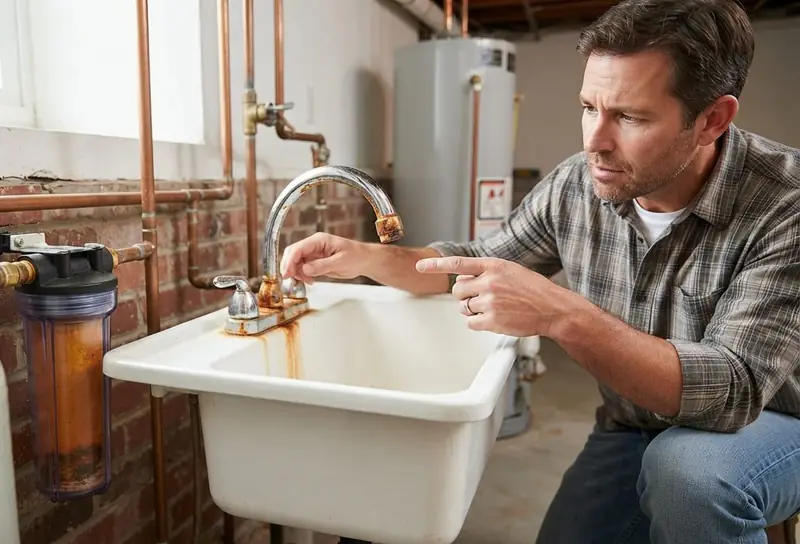
Signs that iron is in your water
- Orange, red or brown stains in toilets, tubs, sinks and around drains
- Rust streaks below faucets and on shower walls
- White laundry that turns yellow or picks up orange spots
- A metallic taste in drinking water, coffee or tea
- Water that comes out clear and turns orange after it sits in a glass
- A softener that seems to stop working, because iron is fouling its resin
The U.S. EPA sets a secondary (non-health) guideline of 0.3 mg/L for iron because staining and taste show up around that level. Iron at those concentrations is mostly a nuisance and a cost: stained fixtures, ruined laundry and shortened equipment life.
A softener can remove a small amount of dissolved iron, but iron that has started to oxidize coats the resin beads and slowly ruins them. That is why an iron problem deserves its own equipment. Our guide on why a softener is the wrong tool for iron explains the chemistry.

Aurora context
Where the iron in an Aurora home usually starts

City water in Aurora is treated at the plant before distribution, and the Illinois EPA’s 2025 report for the system lists no iron violation. So when orange water shows up in a city-served home, the first suspects are usually inside the property or nearby: old galvanized pipes shedding rust, a water heater tank that is corroding, or sediment stirred up by work on a water main. Main-work discoloration usually clears after running a cold tap for a while.
Homes on a private well are different. Groundwater in northern Illinois often carries dissolved iron, and a well owner is responsible for testing it. If you are on a well and see staining, a lab test for iron (and manganese, which leaves black or brown marks) is the starting point. An iron filter is most often the answer in that situation.
The fix
How an Iron Curtain-style filter works
Iron Curtain is a product name used for a type of air-injection iron filter. The idea is straightforward. The filter keeps a pocket of air at the top of its tank. Incoming water passes through that air, and oxygen turns dissolved iron into solid particles. Those particles are then trapped in a media bed below. On a schedule, the filter backwashes the trapped iron to the drain and refreshes its air pocket.
Because it uses air rather than chemicals, this type of filter has no chemical feed to refill. It is installed ahead of the softener so the softener only ever sees water that is already low in iron. That protects the resin and lets each piece of equipment do the job it is designed for.
When a different approach fits
Air-injection filters work well within a range of iron levels, pH and flow. Very high iron, high manganese, iron bacteria or a strong rotten-egg smell can call for a different treatment. A water test tells you which side of that line your home is on. Where the public evidence for a specific product is thin, we talk about the type of filter rather than promising a brand.

What to expect
Getting an iron filter installed
- Call and describe the staining. Where it shows up, hot or cold water, city or well.
- Get a number. A lab test for iron, manganese and pH, especially on a well, tells us whether an air-injection filter is the right type.
- Choose and install. The filter goes in ahead of the softener with a drain for backwash, and we explain the backwash schedule and what to watch.

Realistic results
What an iron filter changes
With iron removed upstream, new orange staining should stop, laundry should stop yellowing and the metallic taste should fade. Existing stains do not disappear on their own; they need cleaning once the source is gone. A softener downstream lasts longer because its resin is no longer coated with iron.
If the stains turn out to come from a corroding water heater or old galvanized pipe, a whole-house filter will not cure the source, and we will say so. Sometimes the right answer is a plumbing repair, not more equipment.
Iron filter questions
Can my softener handle the iron instead?
Only small amounts of dissolved iron, and at the cost of resin life. Visible staining usually means a dedicated iron filter is the better choice.
Is iron in water a health problem?
At typical household levels it is treated as a nuisance: the EPA’s 0.3 mg/L figure is a secondary guideline for taste and staining, not a health limit.
Do you work on private wells?
Yes. Well water should be tested first, because iron, manganese and pH decide the right filter.
Contact Aurora Water Softener
Tired of orange stains?
Call Aurora Water Softener about an iron filter for your home. Call us or use the form to describe what you are noticing at the tap.
Call 331-258-1848 Map location: 403 West Galena Boulevard, Aurora, IL 60506Send a message
Tell us about your water
Share your question and contact details in the form below.